National Project ‘Technological Support for Food Security’
Since 2025, a national project has been implemented to develop genetics, breeding, and the scientific and technological capacity of Russia’s livestock sector. The horse-breeding industry is covered through the ‘pedigree livestock breeding’ and ‘development of the agro-industrial complex’ subareas.
| National-project area | Opportunities for horse breeding |
| Genomic technologies in livestock production | Subsidies for creating genetic databases and conducting breed testing |
| Domestic breeding | Funding to develop new breeds and conserve rare horse breeds |
| Scientific and educational centers | Partnerships with the All-Russian Research Institute of Horse Breeding and the Timiryazev Academy |
| Digitalization of pedigree records | Integration with the Federal State Information and Analytical System ‘Breeding Resources’ (FGIAS PR) and the ARK information and analytical system |
| Support for exports of animal-husbandry technical services | Exports of breeding material to EAEU countries and China |
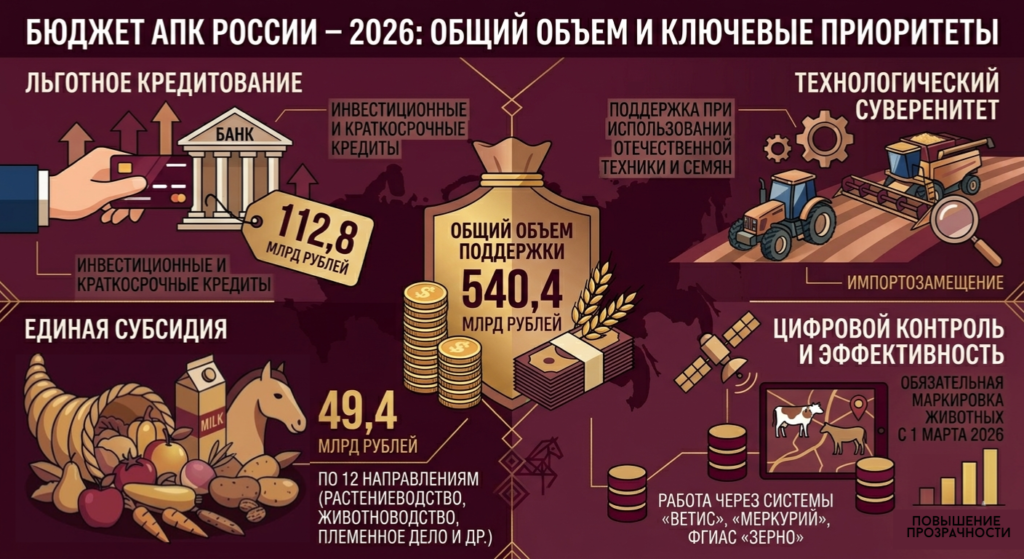
Text of the Russian infographic – translation
Translation of the Russian infographic's labels, not verification of current subsidy eligibility or terms. Questionable dates, amounts and incomplete labels in the source are retained and identified; this translation does not amend the Russian source.
Russia's Agro-Industrial Budget – 2026: Total Funding and Key Priorities
Total support: RUB 540.4 billion.
Preferential lending. Bank; investment and short-term loans (the label is repeated); RUB 112.8 billion.
Consolidated subsidy: RUB 49.4 billion across 12 areas (crop production, livestock production, breeding and others); ‘MILK’ on the carton.
Technological sovereignty. Support for using domestic machinery and seeds; import substitution.
Digital monitoring and efficiency. Mandatory animal identification from 1 March 2026; operation through VetIS, Mercury and the federal state information and analytical system ‘Grain’; greater transparency. [The animal-identification date requires the source correction review described in the audit.]