Russia and China: practical steps toward bilateral trade in the equine industry
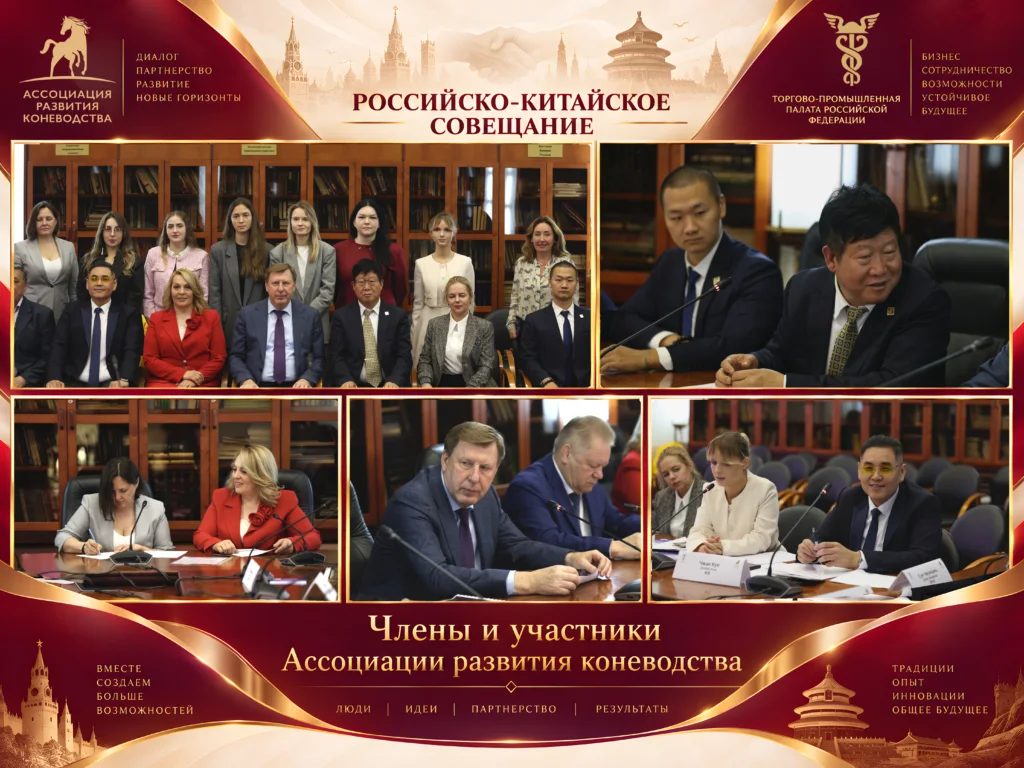
On September 18, the Chamber of Commerce and Industry of the Russian Federation hosted a business meeting entitled “Bilateral trade between Russia and China in the equine industry,” organized jointly by the Chamber and the Horse Breeding Development Association.
Vladimir Ivanovich Padalko, Vice-President of the Chamber, delivered the welcome address. The meeting was moderated by Pyotr Alexandrovich Chekmarev, Chairman of the Chamber’s Committee on Agribusiness Development.
The Russian side was represented by Oksana Vladislavovna Zhavoronkova, Director of the Horse Breeding Development Association; Anna Sergeyevna Zaretskaya, representative of the Russian Equestrian Federation; and Yuri Vladimirovich Filippov, representative of ROKSIS, the Regional Public Organization for Equestrian Sport of the Republic of Buryatia.
The Chinese delegation comprised:
— Song Zhongshan, President of the China Horse Industry Association (CHIA);
— Xing Enze, Deputy Secretary-General of the China Horse Industry Association;
— Zhang Kuo, Director of Jinan Nayi Commercial Operation Management Co., Ltd.
The central topic was the establishment of a sustainable system of bilateral trade between Russia and China across all segments of the equine industry. Participants discussed prospects for supplying breeding horses, sport horses and working horses, feed and feed additives, veterinary medicines, tack and equipment. They also considered cooperation in veterinary medicine, horse training, specialist education, equestrian sport and tourism.
Particular attention was paid to the Russian–Chinese veterinary protocol, which currently remains the main obstacle to establishing regular horse shipments. The parties considered agreement on the list of required tests, quarantine conditions, accreditation of Russian establishments, the use of electronic veterinary certificates, and mutual recognition of veterinary inspection results.
Following the discussion, participants proposed establishing a joint working group involving the Horse Breeding Development Association, the Chamber of Commerce and Industry of the Russian Federation, the China Horse Industry Association, and the relevant government bodies of both countries. Its tasks would be to prepare agreed proposals for improving the veterinary protocol and to develop a draft intergovernmental agreement on cooperation in horse breeding and bilateral trade.
Another area of work was implementation of the memorandum on establishing a joint Russian–Chinese venture, signed on June 24, 2026, in Guangzhou. Participants discussed preparation of a road map, procedures for selecting and preparing the horses, veterinary and customs support, logistics, and arrangements for concluding foreign trade contracts.
A significant event during the meeting was the signing of a memorandum between the Horse Breeding Development Association and the Russian Equestrian Federation. The document aims to bring together participants in the equine industry, restore the sector’s breeding and production cycle, and establish a system of self-regulation in pedigree horse breeding. It marks another important step toward uniting the professional community and coordinating work in the interests of the entire sector.
The meeting at the Chamber provided a forum for substantive dialogue that translated the interests of government, the professional community and business into practical action. Russia and China are moving from discussing prospects to developing concrete mechanisms for cooperation, with clearly defined tasks, responsible participants and a focus on long-term results.